
Defence

DEFENCE.1

The AI-Native Coordination Layer for Defence Ecosystems

Sale to Support Cancer Research

MTD.1 sale - 6th May 2026


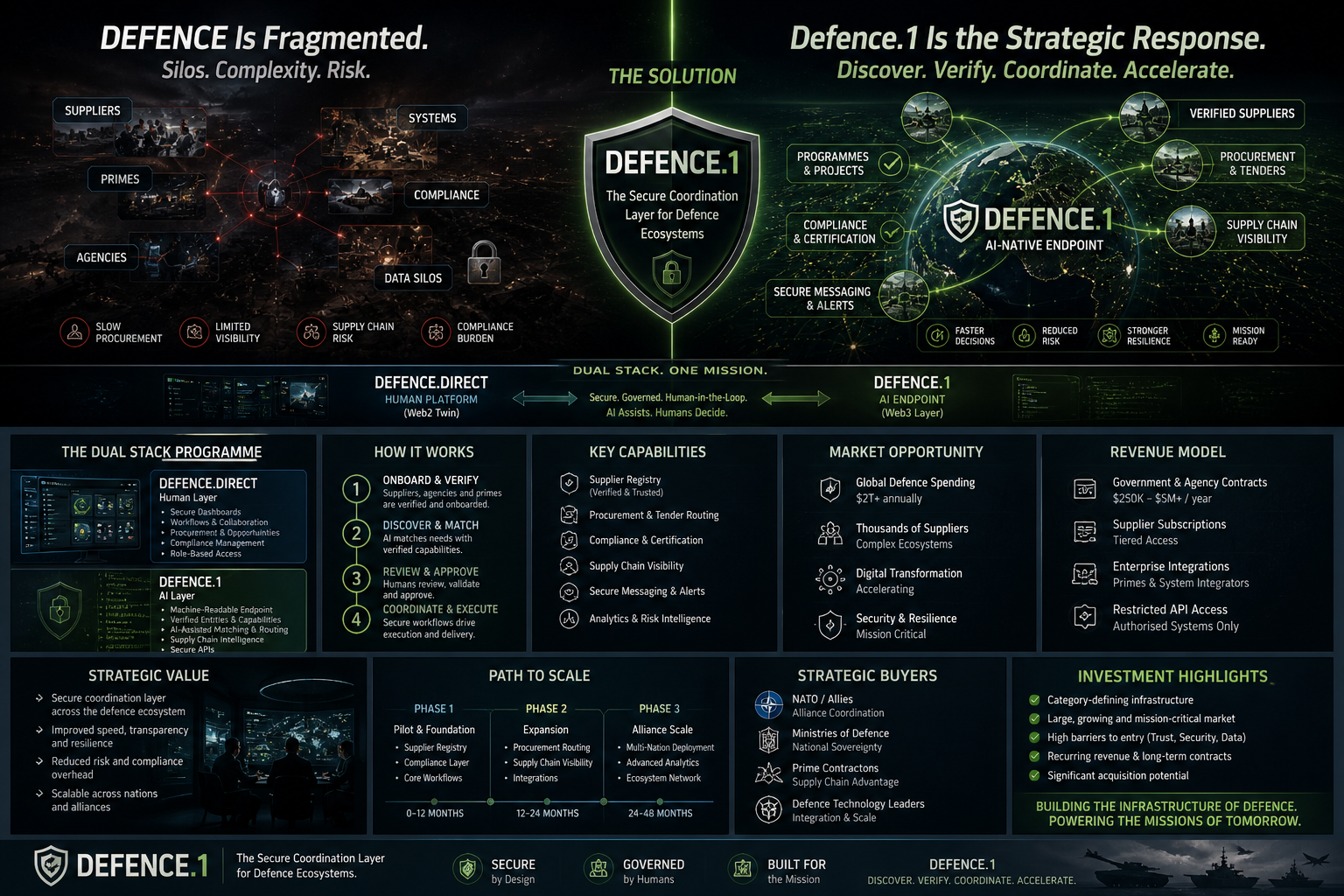
THE PROBLEM

Defence ecosystems today are:

  • Fragmented across suppliers, primes, and agencies
  • Slow in procurement and supplier discovery
  • Weak in real-time supply chain visibility
  • Burdened by complex compliance requirements

    These are Critical inefficiencies in a high-stakes environment

    THE SHIFT

    AI is transforming:

  • procurement
  • supply chains
  • coordination

    But:

    ❌ No secure, structured AI layer exists for defence ecosystems

    THE SOLUTION

    DEFENCE.1 + DEFENCE.DIRECT

    A Dual Stack Programme that will provides:

  • secure supplier discovery
  • compliance visibility
  • AI-assisted coordination (human approved)

    MARKET OPPORTUNITY

  • Global defence spending: $2T+ annually
  • Thousands of suppliers and contractors

    Increasing demand for:
  • supply chain resilience
  • digital coordination
  • compliance automation

    BUSINESS MODEL

  • Government contracts:
  • Supplier subscriptions
  • Enterprise integrations
  • Restricted API access

    WHY NOW

  • geopolitical instability
  • supply chain vulnerability
  • AI adoption in defence
  • Web3 and AI agents

    Web3 is very useful when you need:

    1. Trust without central authority

  • identity verification
  • ownership
  • provenance

    e.g. verifying:

  • a canonical endpoint
  • a data source
  • an agent identity

    2. AI Agent-to-AI Agent transactions

  • payments (tokens, stablecoins)
  • micropayments between agents

    This is difficult in Web2 without intermediaries

    3. Immutable records

  • audit trails & compliance logs
  • certification

    4. Decentralised naming / discovery

  • domains (ike .1 )
  • registry layers

    The Future is a Dual Stack model

    Web2

  • execution
  • dashboards
  • workflows

    Web3

  • identity
  • canonical endpoints
  • verification layer

    Web3 becomes increasingly dominant as:

  • agent-to-agent commerce grows
  • decentralised identity becomes standard
  • canonical endpoint registries become widely adopted
  • .1 DOMAINS AS CANONICAL AI ENDPOINTS

    A. Concept Purity (Very High)

  • .1 is unusually strong semantically:
  • “.1” ⇒ first / primary / authoritative
  • aligns naturally with: canonical endpoint; root resolution; “best answer” selection

    Why that matters

    AI systems move toward single-answer resolution, not lists. .1 fits that model better than almost any other naming structure.

    B. Native Fit for Canonical Endpoints

    Canonical endpoints need to be:
  • unique
  • deterministic
  • memorable
  • system-readable

    C. Alignment with Handshake’s Design

    Handshake was designed specifically for:

  • replacing / augmenting DNS root
  • decentralised TLD ownership
  • censorship resistance

    Benefits here:

  • you can control top-level names, not just subdomains
  • no central ICANN gatekeeping
  • cryptographic ownership
  • The above is critical for canonical infrastructure

    D. Cryptographic Control

    Handshake domains are:

  • wallet-controlled
  • transferable
  • provably owned

    This enables:

  • canonical endpoint integrity
  • verifiable control of namespace

    .1 can't be replicated on other Blockchains

    Naming Systems Are Sovereign Per Protocol. Handshake operates its own root namespace.

    That means:

    .1 exists inside Handshake’s root zone; ownership is enforced by blockchain consensus, and cryptographic keys. Another blockchain cannot “reuse” .1 in any authoritative way.

    Analogy

    Two organizations can both print: “banknotes”

    But only one is recognised as legal currency. The Same applies to namespace authority.